The whole method fits in one sentence. Open the shutter for a few seconds in a black room, put a light where a bubble is going to drift past it, and the sensor records every position that bubble occupied as one continuous streak. The bubble writes its own path.
The light in that sentence is not a detail. A bubble emits nothing, so it needs something to reflect, and everything you see in these photographs is light that left a lamp, bounced off a film a few hundred nanometers thick, and picked up its color from the thickness of the spot it hit. The bubble is the mirror. The light is what it shows you. How much light that takes turns out to be most of the story of this project.
Everything after that is about making a chaotic subject land in the one place the camera is looking.
The focus plane is the trick
This is the part I would tell anyone trying it.
Two tube lights sit perpendicular to the lens, one horizontal and one vertical, bracketing a slab of air a few meters out. That slab is the only lit space in the room. I focus manually on the distance of the tube lights and then leave it, because autofocus has no chance against a transparent object moving unpredictably in the dark.
Then I blow bubbles from behind the camera, forward, so they travel away from me and into that lit slab.
The result is that the photograph makes its own decisions. A bubble is invisible until it enters the lit plane, sharp only while it crosses it, and gone again on the far side. I am not chasing focus or timing a moment by eye. I built a place where the picture is correct, and I wait for a bubble to wander into it.
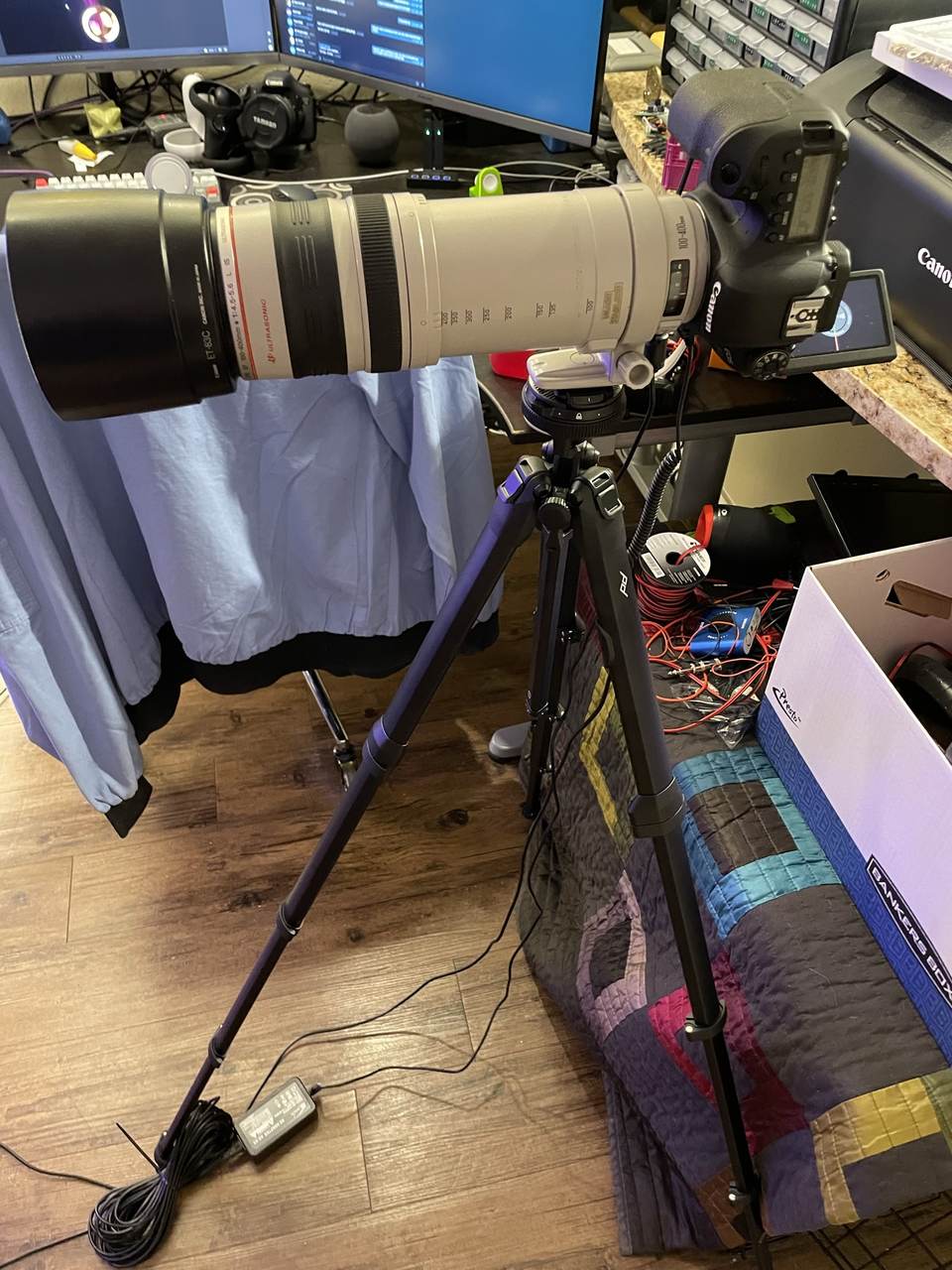
400mm at the far end of the room, which keeps the rig, the lights, and me out of frame.
The settings barely changed in three years
Manual, bulb, raw. f/11 to f/16, because at 400mm a bubble a few meters away has almost no depth of field and the trail travels through depth as well as across the frame. ISO 400. Three to five seconds, which is roughly how long a bubble is worth watching.
The shutter is not pressed. The camera is in bulb and an optocoupler in the rig holds it open, so the exposure length is a number in a menu rather than a thing I do with my thumb.
Two lights doing two jobs
The tube lights are continuous, they are on DMX, and the rig fades them during the exposure. Because the bubble is moving the whole time, a fade across time becomes a gradient across space: the trail can start bright and end dim, or start at one hue and land on another, and the transition is a real thing that happened in the room rather than a gradient applied afterward.
The strobes are two Godox heads doing the opposite job. They fire once, for a fraction of a millisecond, and freeze the bubble as a sharp object. First curtain puts the crisp bubble at the beginning of its trail and second curtain puts it at the end, which reads much better, because then the trail is the wake of something that is visibly there.
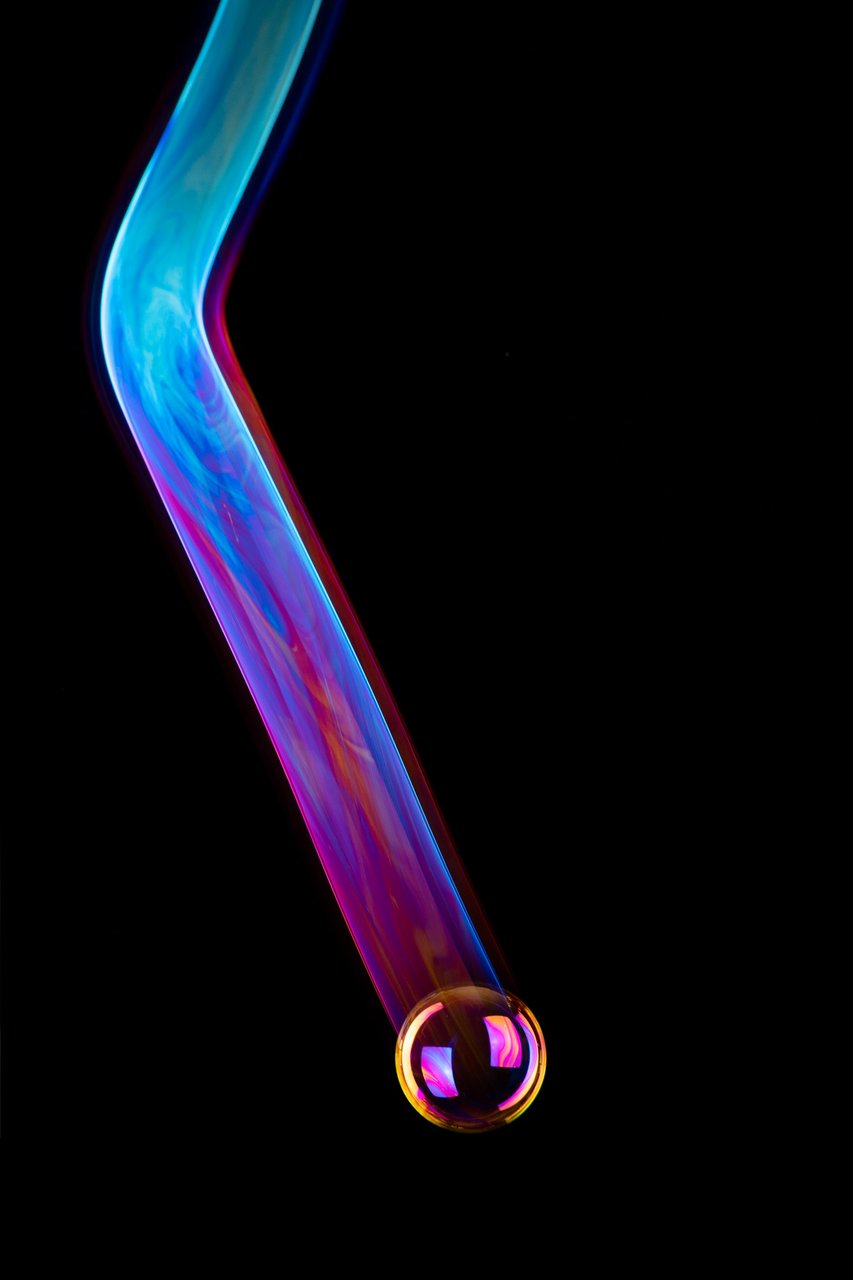
Second curtain. The trail arrives at a real bubble, which is the whole argument for firing the flash last.
Light quality mattered more than I expected. I metered the sources rather than guessing at them, because the color in the subject is a physical measurement and washing it through a source with holes in its spectrum throws the readout off.
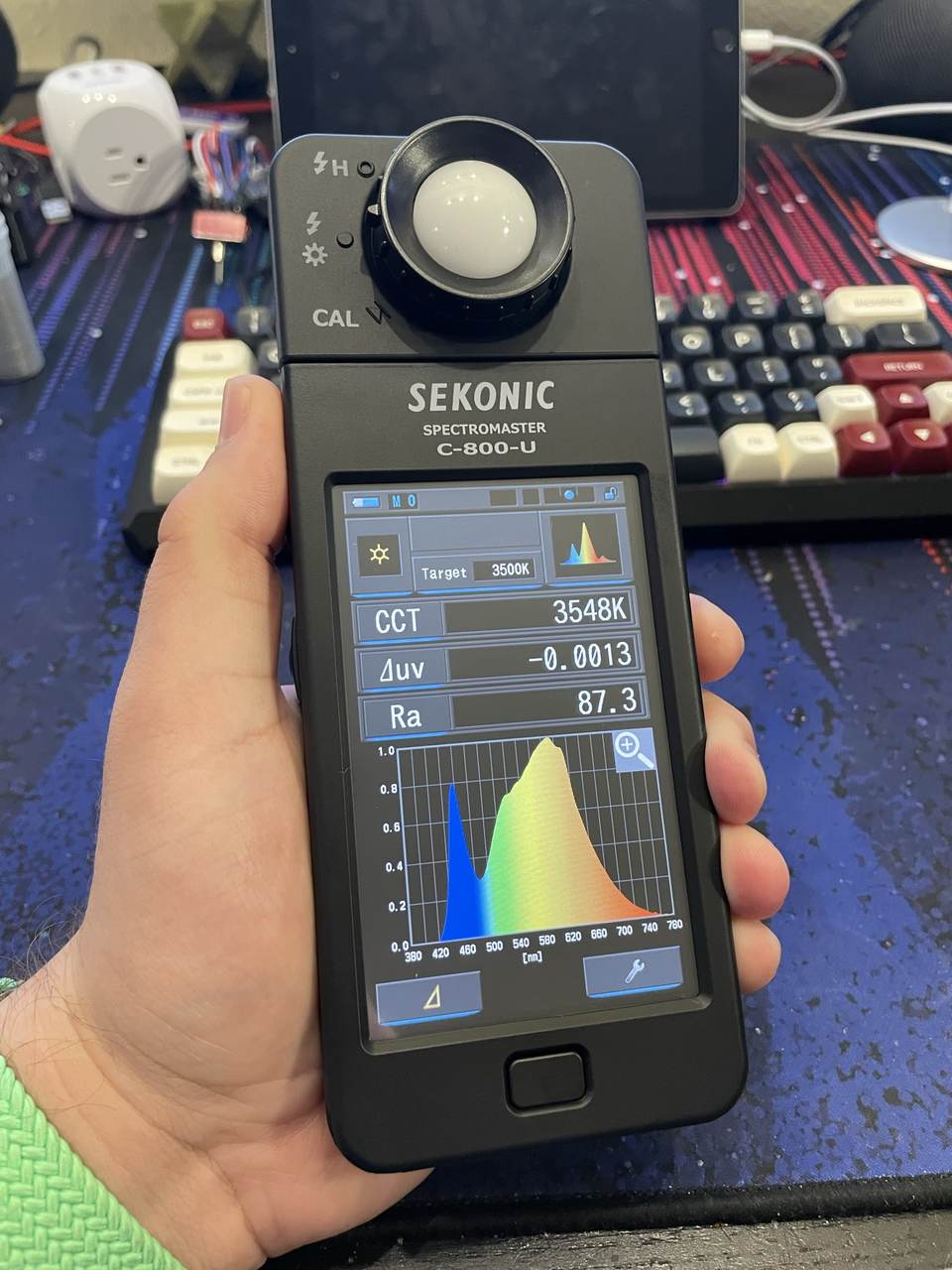
What the rig does
The sequence has to land in the right order inside a five second window: run the bubble machine, hold for a moment, open the shutter, fade the light across the exposure, fire the strobe on the correct curtain, close the shutter. Doing that by hand means being several people at once.
So it is one foot pedal. The Photonic Encabulator runs the sequence, and the interesting part is that it calibrates itself: it measures how long a DMX frame actually takes to write on the board it is running on, then works backward so the light fade finishes exactly when the shutter closes.
The soap recipe I am keeping to myself. It is the one part of this I have never written down, and the levers are more useful than the formula anyway: surfactant, water, dilution, pH, and how much glycerin, all of which trade lifespan against how quickly the film thins into the colors you want.
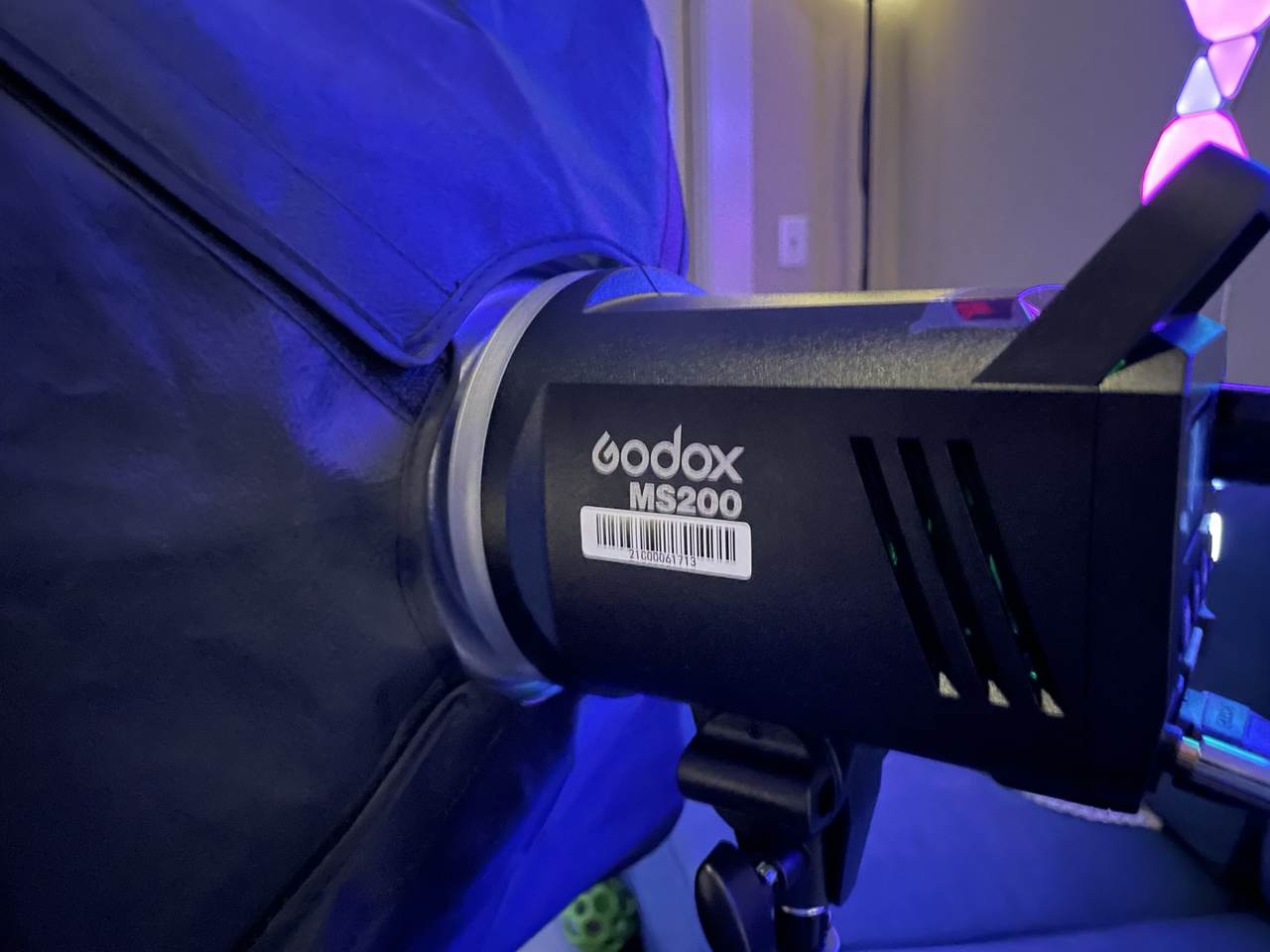
What goes wrong
You cannot art direct the path of a soap bubble.
Mostly they simply do not turn up. They drift to the corners, they hug the edges, they pop early, or they cross the frame somewhere that is not the lit plane and leave nothing at all. That is the honest ratio behind 21,917 frames.
I tried fans. Indoor air currents you cannot see move a bubble far more than you would think, and a bubble is light enough to take orders from the room rather than from me.
Which is the deal the whole project is built on. The rig exists to make everything except the bubble deterministic, so that when a bubble does something worth photographing, the camera is already correct. A good image happens when preparation meets happenstance.