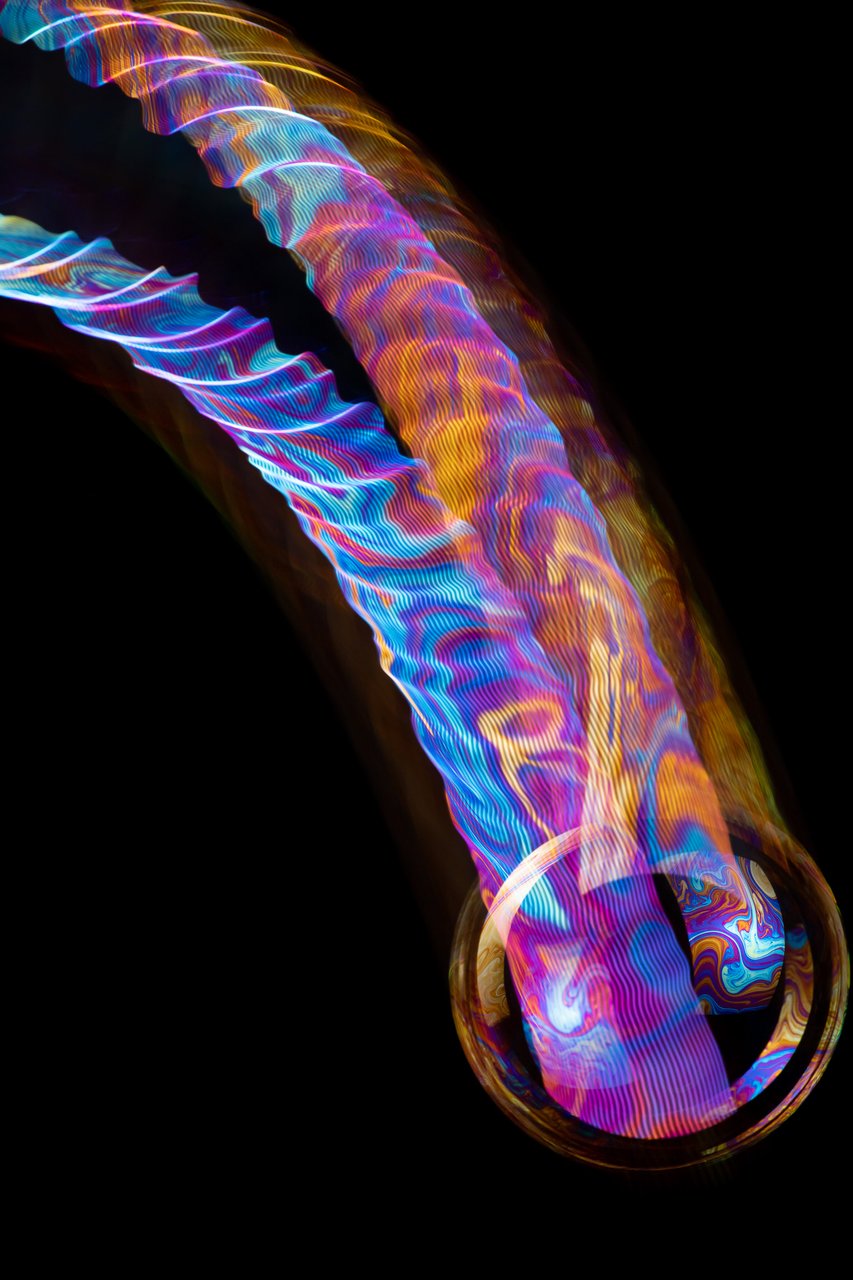
A soap bubble drifts across a pitch black room. The shutter stays open for four seconds. What lands on the sensor is not the bubble. It is the path the bubble took, painted in the colors of its own film.
I shot this for three years: 21,917 raw frames across 97 sessions between 2021 and 2024. The recipe barely moved in all that time. A Canon 6D Mark II, a 100 to 400mm lens racked all the way out to 400, f/11 to f/16, ISO 400, three to five seconds. Everything interesting happens in front of the camera rather than inside it.
The color is not a filter or a gel. A soap film is a layer of water a few hundred nanometers thick with soap on both faces, and light reflecting off the front surface interferes with light reflecting off the back. Which wavelengths survive depends on how thick the film is at that exact spot, so the color you see is a direct readout of thickness. As a bubble drains it thins from the top down and its colors march through a fixed sequence, then it goes clear and pops. Every hue in these photographs is the bubble measuring itself.
The parts of it
- The technique is the whole method: the focus plane the bubbles get blown into, the long exposure, and the strobe that freezes one at the end of its own wake.
- The blackest black is how I ended up importing flock fabric from Japan because the background is the entire photograph.
- Encoded trails is what happens when the light blinks instead of glowing, and the trail records the blinking as pattern.
- The Photonic Encabulator is the machine that runs all of it. Four versions, three of them destroyed, one that worked.
Where it started
A friend got me into light painting in high school, standing in the dark drawing on long exposures with flashlights. Then Akira, and wanting the light trails the motorcycles leave through Neo-Tokyo, badly enough to try making them for real. A bubble happened to drift through a room I was experimenting in, caught the light, and that was the subject sorted.
I made the first ones in college around 2011 on a Rebel T2i with black posterboard and an eight point LED flashlight. They were hit or miss, and for years I filed them as the rough draft: the idea proven, badly, before I had the equipment to do it properly. They also taught me the thing the whole project rests on, which is that without a truly black background there is nothing to see.
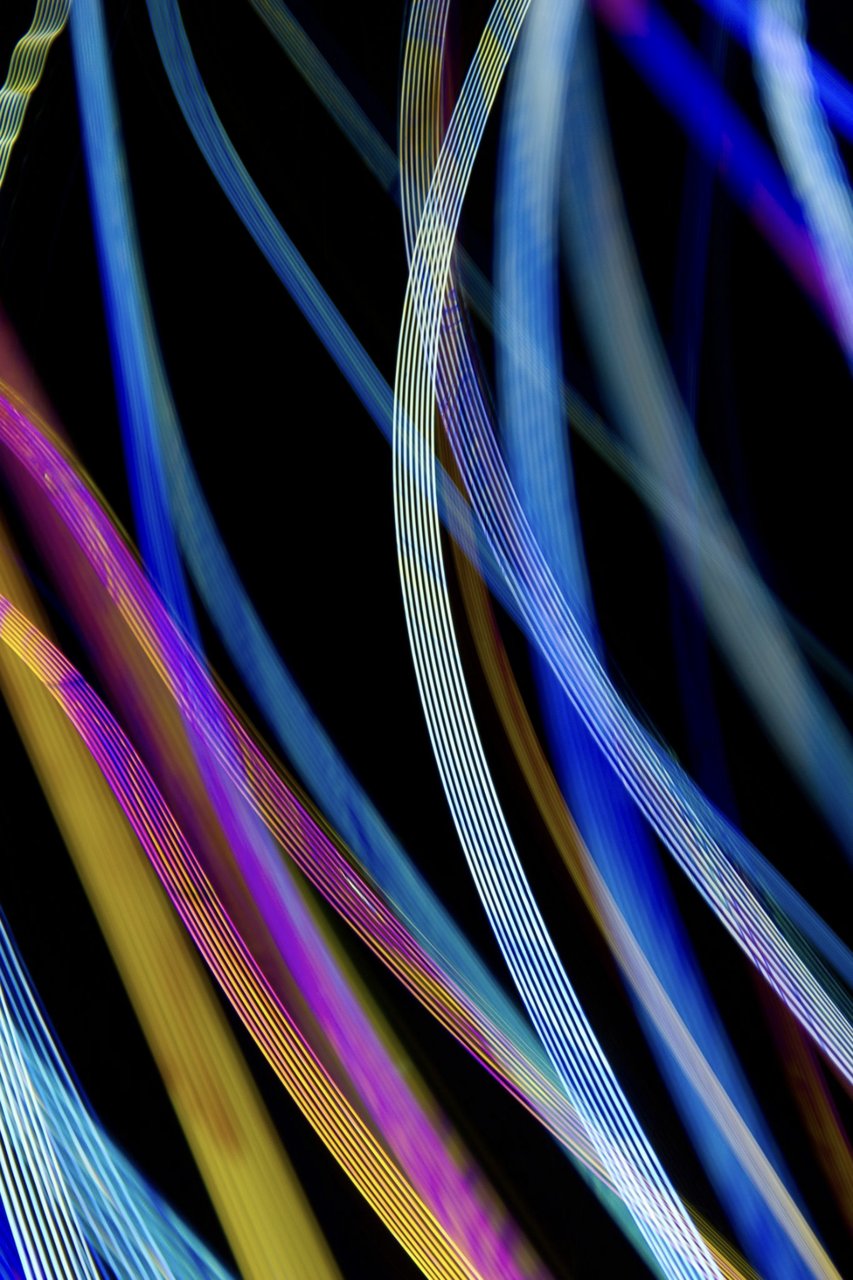
College, around 2011. The trails come out striped because the flashlight had eight separate LEDs in it, so each bubble drew a bundle of parallel lines instead of one smooth ribbon.
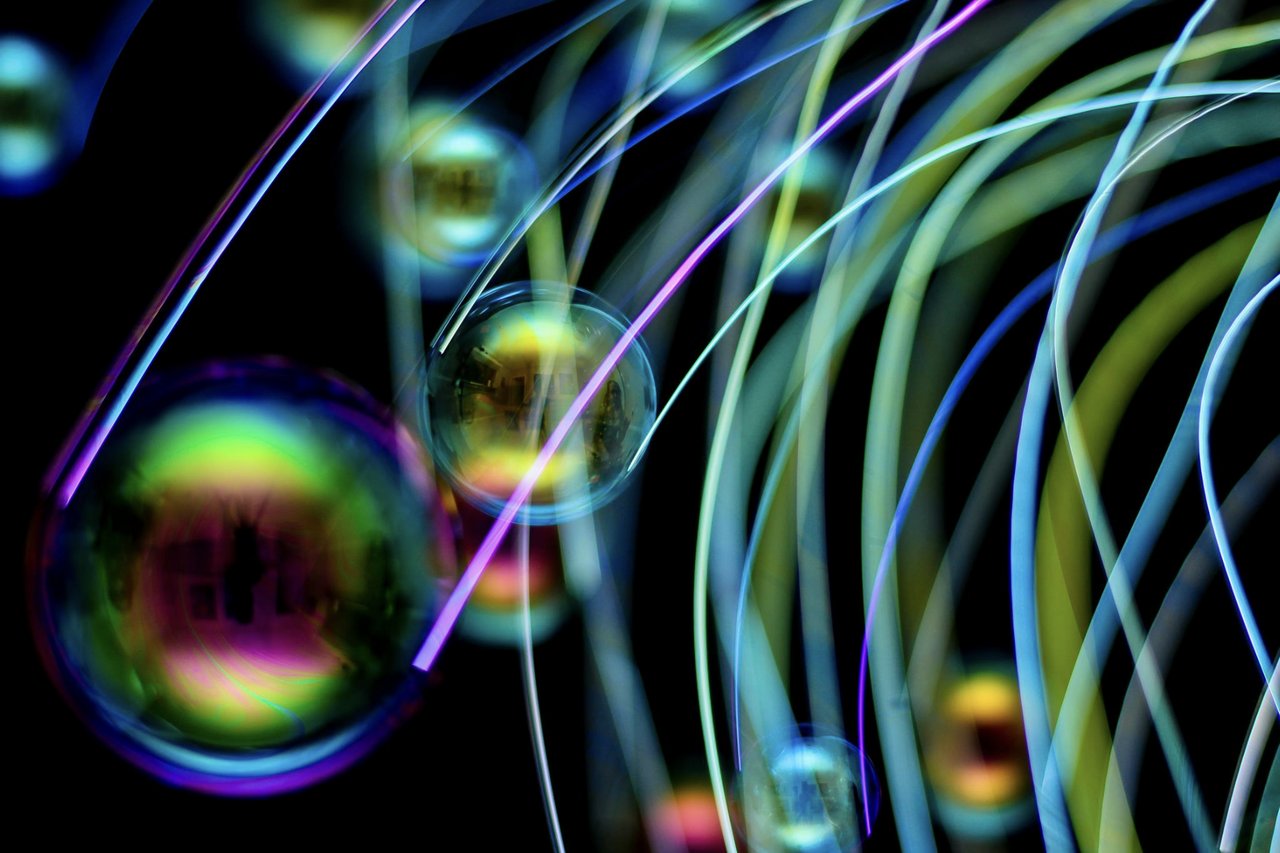
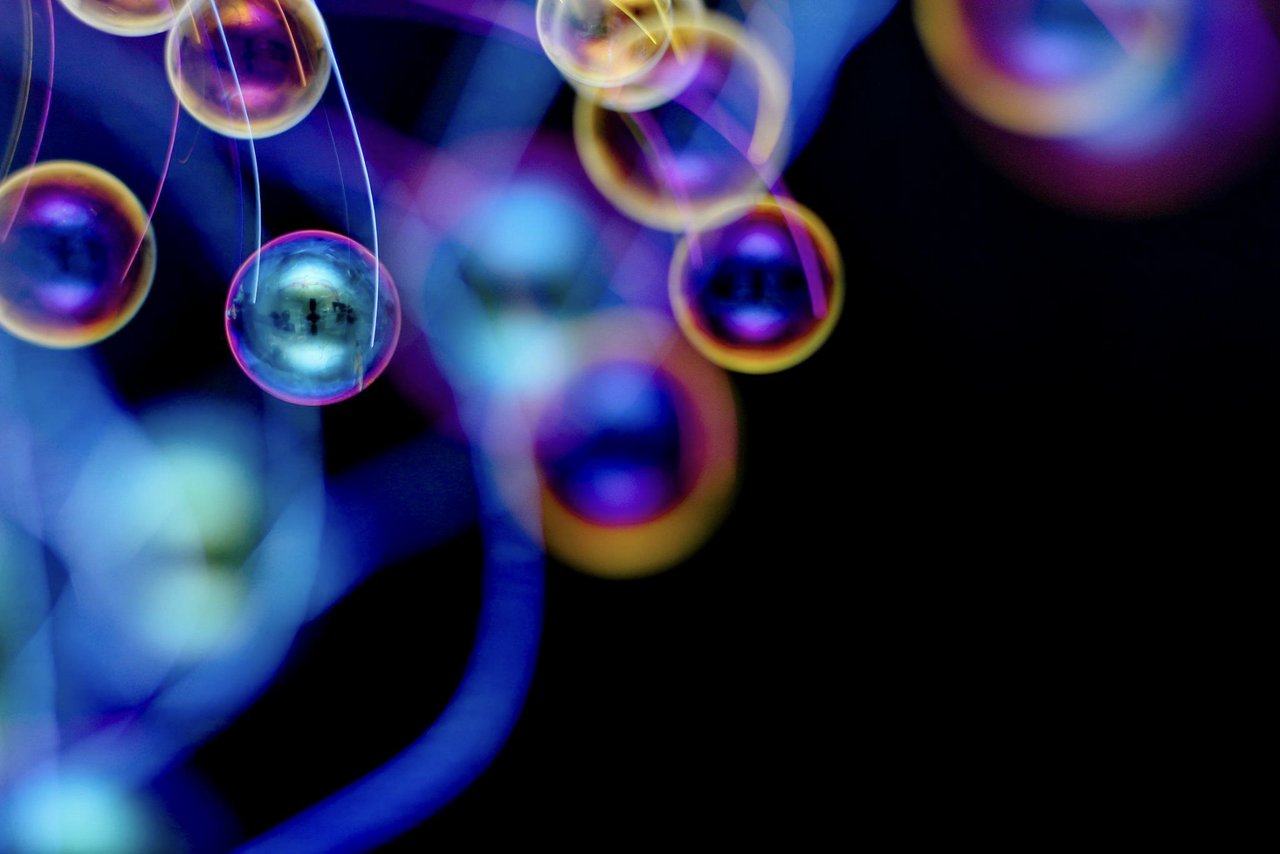
Putting them on this page is the first time I have looked at them properly in a decade, and the rough draft reading does not hold up. Three things are happening in those frames that I did not put there on purpose. There are rooms inside the bubbles: windows, a doorway, furniture, bent around a soap film. The trails have internal structure, because eight separate LEDs draw eight separate lines. And there are bubbles at every distance, so the frame has depth rather than a single gesture crossing it.
It was a cheap flashlight in an ordinary room. I get into what that turns out to be worth at the bottom of this page.
I picked it back up in 2021, during that stretch of a few years where I did not go outside much, and fell into an absolutely wild creative mania. Nothing like I have experienced before or since. It is what kept me up at night and what kept me up during the day. More than half of the 97 sessions happened in that year alone, May through December, which is what the mania looks like plotted on a calendar.
By then I had spent a decade building pipelines for animation and VFX, which meant I had experience with removing variables from a process. A bubble’s path is genuinely uncontrollable and that unpredictability is the good part. Everything else is a timing problem, and timing problems can be solved with hardware, so I learned to solder.
Where they went
Four of them are two by three foot framed prints. Two hang at home and two hang in my studio. Smaller ones have sold and traded. The large prints have been in a couple of group shows.
The first was an open call at the Lost Pines Art Center in Bastrop, and I got there the least mysterious way available. When I decided to stop only making things and actually get involved in the art scene, the first people I contacted were my own art school, and by then the Art Institute of Austin had moved into the Lost Pines building. So the first show I was ever in was in the place my school had moved to.
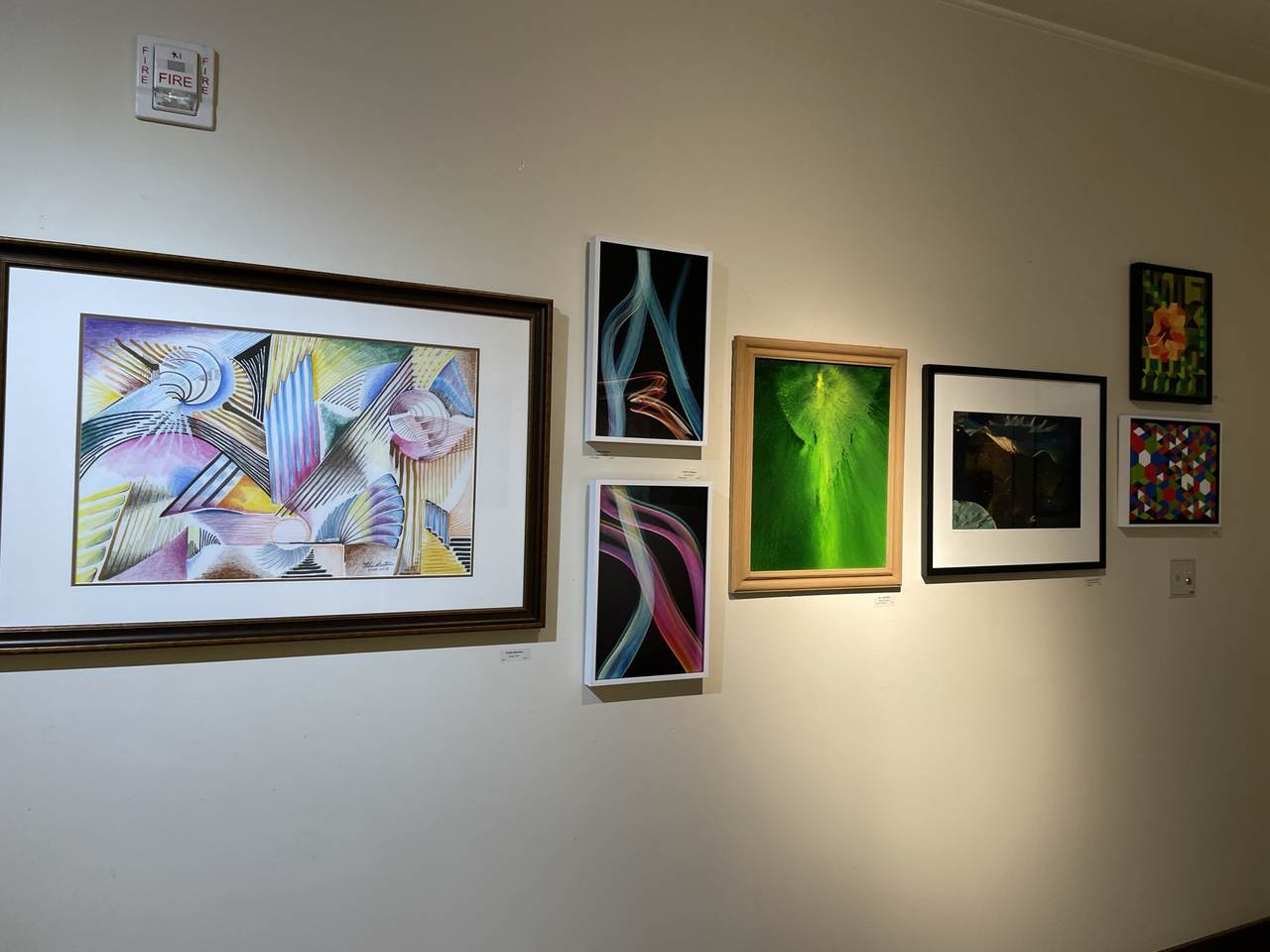
Lost Pines Art Center, Bastrop. The first show I was ever in.
The project has been paused since the middle of 2024. What happened is that the electronics turned into a career: building the rig led me to be able to work with Mixim. Then Matt took over the room I shot in. Paused rather than abandoned. The rig still works and I still have all 21,917 frames.
What I actually think of them
Here is the part a portfolio page normally leaves out.
The smooth trails have a ceiling and I hit it. Not a craft ceiling. The problem is that the photographs hide their own difficulty. Photography’s best trick is making someone ask how on earth you captured that, and nothing about a smooth iridescent ribbon on black says it was ever in front of a lens. It could be a gradient mesh. It could be a render. It could be a prompt. The thing that makes the work worth doing, that it is real and it happened once and it took a machine to catch, is invisible in the pixels.
So the honest reaction to most of them is that they are pretty, and pretty is the ceiling of decoration. It does not help that thin film interference hands you the same magenta and cyan and gold every time, so a hundred frames tell one color story. The second photograph teaches you the trick and the rest confirm it.
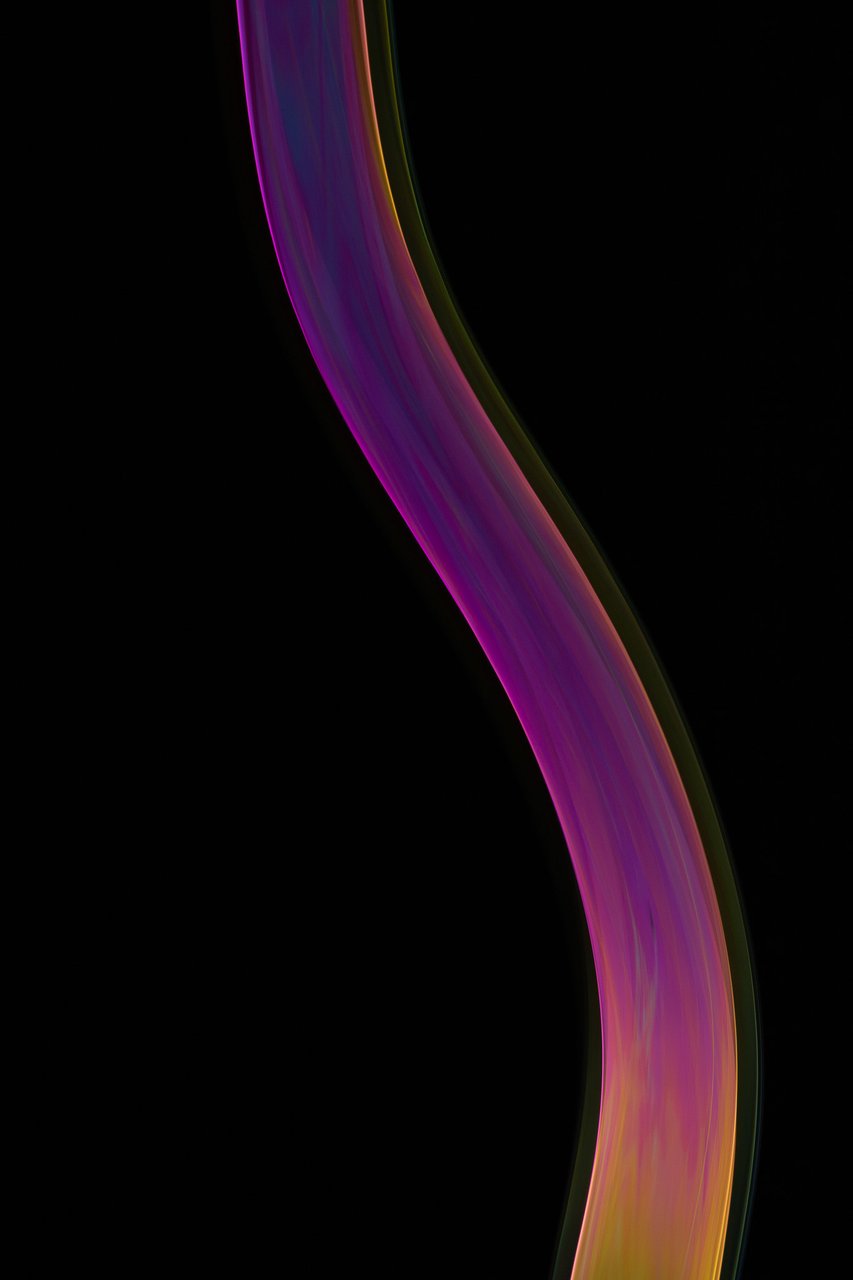
This is the problem in one frame. Nice, and it tells you nothing.
The frames that escape it all have the same thing in common: something in them could not have been faked. An intact bubble sitting at the end of its trail, giving you scale and a real object. Or texture with too much structure to invent, the moiré and marbling that come out of a film interfering with itself.
Which brings me back to the college photographs, because by that test they beat most of what I made afterward with the better camera and the machine.
A bubble is a mirror. It reflects whatever is around it, and in 2011 what was around it was a room with windows in it. You can see that room wrapped around the film, upside down and stretched. It is the most unambiguously photographic thing in the entire project and I made it before I knew what I was doing.
Then I spent years deleting the room. Three meters of the blackest fabric on earth, every light in the place killed except two tubes pointed at a slab of air, 400mm to crop the rest of the world out of frame. Every one of those decisions is correct on its own terms, and all of them are aimed at contrast. But a bubble floating in a room that has been erased has nothing left to reflect. Chasing the perfect black took the referent out of my own photographs, and I never noticed, because each step was an obvious improvement on the last.
The trails went the same way. One smooth tube light makes one smooth ribbon. Eight cheap LEDs made a bundle of parallel lines with structure in it, which is the identical principle I later built a row of thirty LEDs and four shift registers to do deliberately. I designed and built hardware to get back to something a hardware store flashlight had been doing by accident in 2011.
So the way forward is partly a way back. Put something real back in the bubble: a window, the studio, a person. Give the light more than one emitter and something to say. Keep the black behind the subject, where it earns its keep, and stop letting it eat the entire room.
That is the version of this I would come back for.