In a photograph made of light drawn on darkness, the darkness carries most of the picture and sets the ceiling on everything else.
A couple of things surprised me here. Photography needs far more light than you would ever think, and as far as I have been able to tell there is no such thing as too much of it. Meanwhile a soap bubble reflects far less light than you would ever think. The film is a few hundred nanometers thick and very nearly transparent, so most of what you throw at it passes straight through and carries on into the room. What comes back to the lens is a thin skim off two surfaces.
Put those together and the problem writes itself. To get a real exposure off something that returns almost nothing, you have to flood the room with light, and flooding the room with light is what destroys a black background.
Any stray light landing on the background lifts the black off the floor. Once that happens the trail is no longer a luminous thing in a void, it is a bright thing on a dark grey thing, and the contrast that made it worth photographing is gone. You can drag the blacks back down afterward, but I did not want to. The point was to get it right in the room.
So the backdrop is what buys the light. Every stop of brightness I could add without the background rising to meet it was a stop I got to spend on the bubble. It was a genuinely hard problem, and it is why a photography project turned into a materials search.
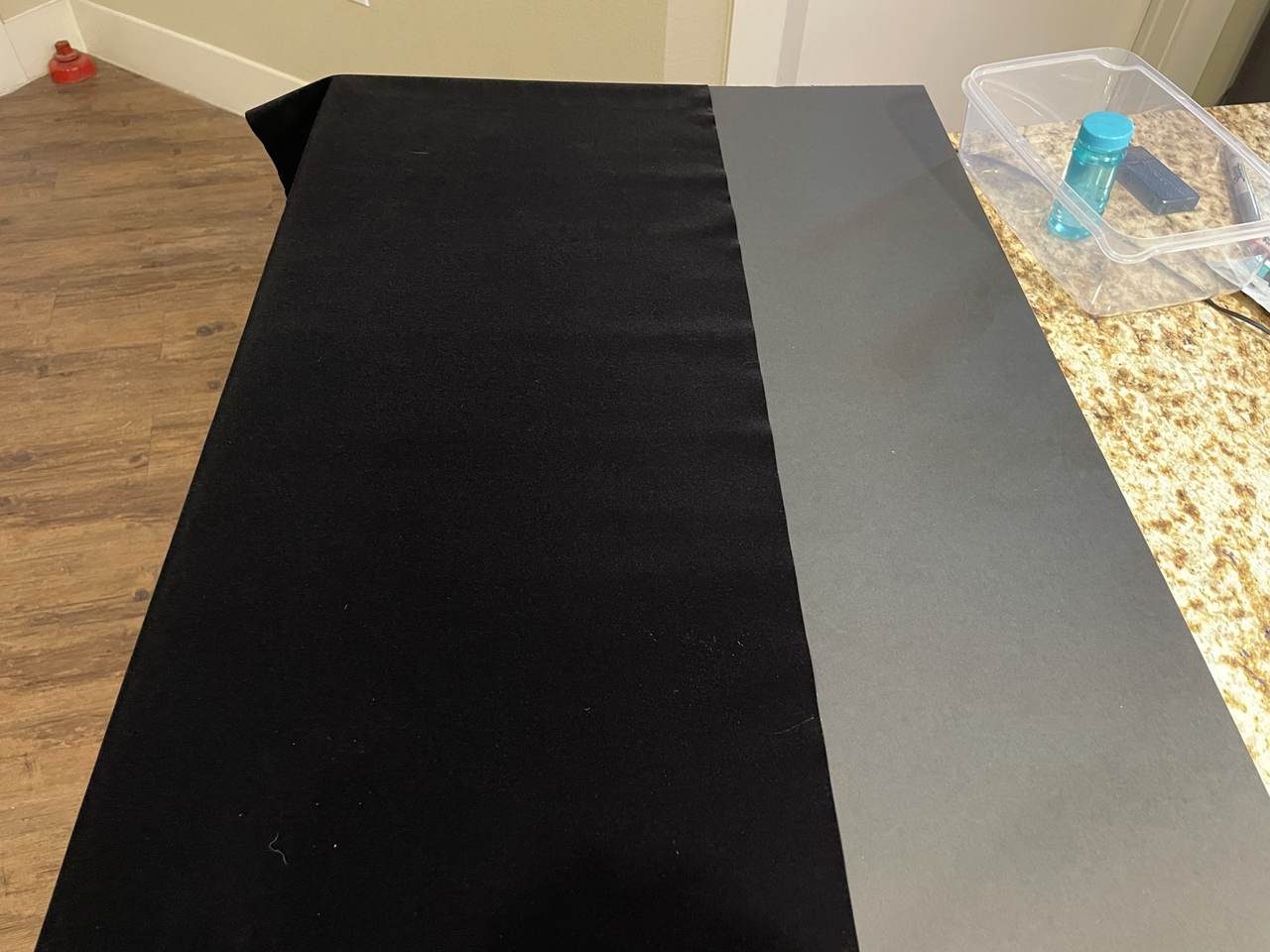
Black posterboard was the college answer and it is not black. Point a light anywhere near it and it returns a dull sheen, because it is a smooth surface and smooth surfaces reflect.
The rabbit hole
If you go looking for a truly black material you arrive within about ten minutes at Vantablack, the carbon nanotube coating that absorbs almost all visible light and looks less like a color than a hole. You cannot have any. Anish Kapoor licensed it for exclusive artistic use, which is one of the great petty sagas of contemporary art, and it prompted Stuart Semple to make his own super black and sell it to everyone on earth except Anish Kapoor. It is a genuinely funny feud and it is also why a hobbyist looking for very black paint has options at all.
The one that turned out to matter is Musou Black, made by KoPro in Japan. It comes as paint and as flock fabric, and which one you get is not really a preference.
The paint is a chemical import, with everything that implies. Some of what is in it is not on the EPA’s inventory of registered substances, so bringing it into the country means claiming a research and development exemption, and that exemption comes with a condition attached: you may only use the stuff for your own research. There is no reading of that under which I paint a photography backdrop with it. The fabric has none of that problem, because a coated textile is an article rather than a drum of chemistry, and it now has a US distributor shipping it domestically.
So the fabric was the only real option, and it turned out to be the better one anyway.
Flock is the reason it works. Instead of a smooth surface reflecting light back at you, it is a dense forest of tiny upright fibers. Light that hits it goes down between the fibers, bounces around, and mostly does not come back out. The surface is not absorbing light so much as trapping it in geometry.
I bought three meters of Musou Black KIWAMI.
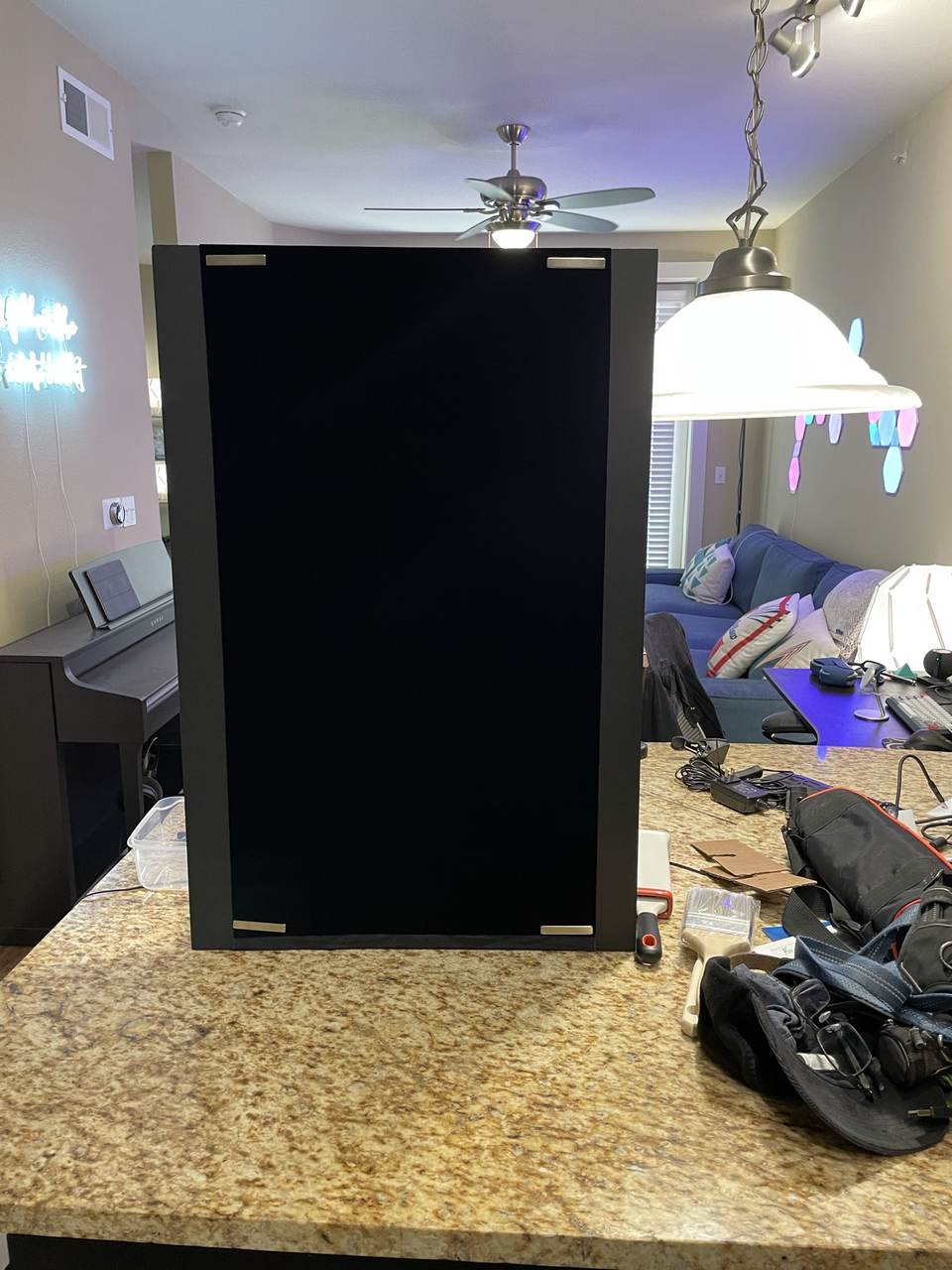
Three meters of it, hung as a backdrop rather than built into a box.
What it changed
It is startling in person. Hung across a room with lights running, the fabric does not read as a black surface, it reads as an absence at the end of the room, and your eye keeps trying to find the wall behind it.
For the camera it meant I could finally turn the lights up. With posterboard the limiting factor was always spill: brighter light meant a brighter background, so past a certain point I was gaining nothing. The fabric broke that trade. I could pour as much light into the room as the bubbles needed, and the background stayed exactly where it was, because it simply was not sending any of it back.
I hung it as a backdrop rather than building an enclosure. The lights sit outside the frame raking across the focus plane instead of pointing anywhere near the fabric, which does most of the work on its own. Fabric is also forgiving in a way paint is not: it takes a crease, it travels, and the flock hides the wrinkles that would ruin a painted panel.
It is the least visible thing in any of these photographs and it is the reason they work, because the subject is a few hundred nanometers of soap and every bit of contrast has to come from what is behind it.